Link to article in Conservation Biology: https://doi.org/10.1111/cobi.70001
Authored by: Brittany Bunce, Elia Apostolopoulou, Sara Maestre Andres, Alejandra Pizarro Choy, Marina Requena-i-Mora & Dan Brockington
Why study the researchers behind conservation debates?
Conservation science does not emerge in a vacuum. It is produced by networks of researchers who share concepts, theories, methods, and often normative commitments about what conservation should be and how it should be done. These networks- known as epistemic communities- play a powerful role in shaping research agendas, defining legitimate knowledge, and influencing policy and practice.
Our recent paper asks a simple but important question: what does the epistemic community studying neoliberal conservation look like, and what does its structure tell us about power, inclusion, and the production of knowledge in conservation science?
Neoliberal conservation scholarship has been central to exposing how market-based conservation approaches – such as biodiversity offsets, carbon markets, and payments for ecosystem services- can reproduce inequality and dispossession, even when framed as environmentally progressive. At its heart, neoliberal conservation critiques how, under a capitalist mode of production, nature has come to be valued primarily for its utility in advancing capitalist growth. Many of the most influential critiques of commodification, accumulation, and conservation capitalism emerge from this literature. Given its critical orientation and political commitments, we felt it was especially important to turn the analytical lens inward and examine how this field itself is structured.
While this paper examines the epistemic community that critiques neoliberal conservation, CONDJUST’s broader research agenda also investigates epistemic communities that shape dominant approaches to biodiversity conservation planning. By studying different epistemic communities we examine how they learn, or fail to learn from each other, and how stronger inter-disciplinarity might be encouraged for more just and inclusive conservation knowledge production.
What we did
We used social network analysis (SNA) to examine patterns of collaboration and influence among researchers writing on neoliberal conservation. Building on a comprehensive review by Apostolopoulou et al. (2021), we analysed a database of 255 core publications authored by 318 scholars, alongside an additional 2,135 papers that cite key figures in this field.
By mapping co-authorship networks, we could see who collaborates with whom, which scholars act as bridges between otherwise disconnected groups, and how influence is distributed across the field. We combined these network measures with author attributes, such as gender and institutional location, and with thematic analysis of research topics. Our aim was not to rank scholars or judge individual careers, but to understand the broader architecture of knowledge production.
What we found
The epistemic community studying neoliberal conservation is dispersed and polycentric. Rather than one tightly connected core, the field consists of many small clusters of scholars working in relatively isolated groups. This structure can be conducive to innovation and theoretical diversity, but it also means that ideas and debates do not always travel easily across the field.
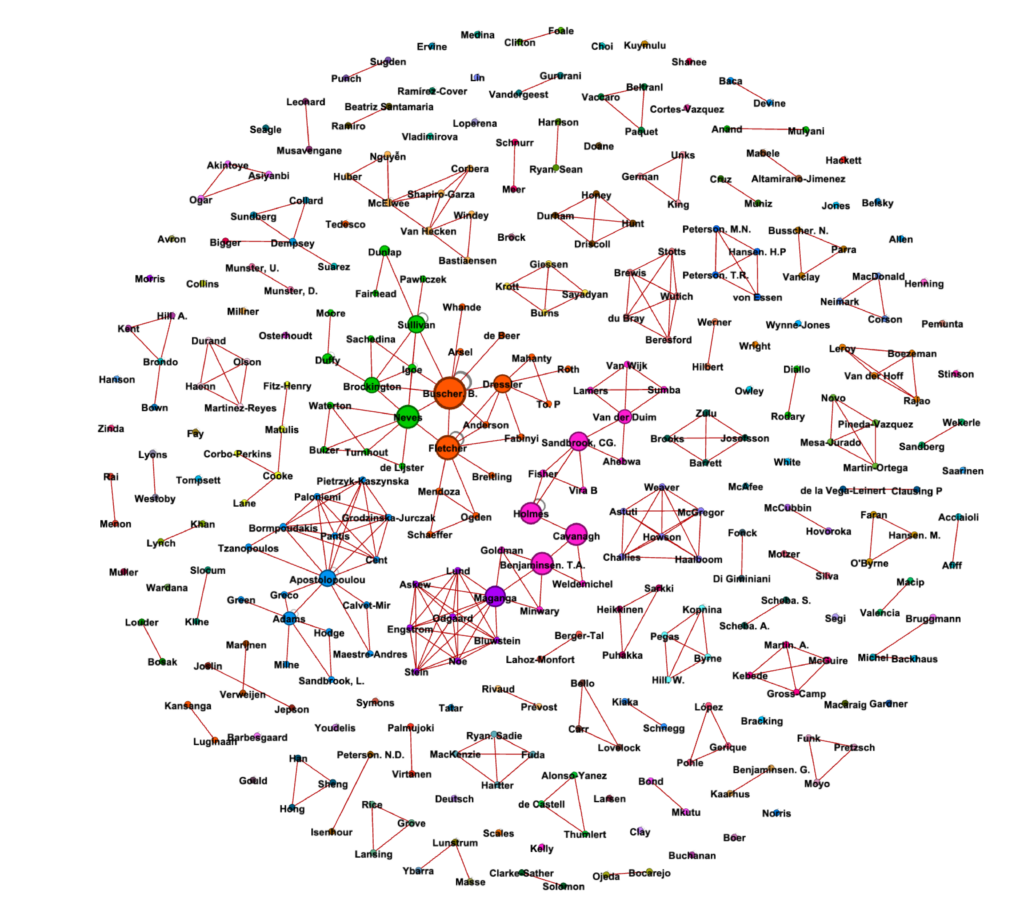
FIGURE 1. Coauthor network of researchers studying neoliberal conservation based on 255 publications by 318 authors (colours, different modularity classes [i.e., Louvain community detection algorithm of cooccurrence of authors in Gephi]; node size, betweenness centrality; modularity score, 0.912; number of communities detected, 130; average path length, 2.4 [indicates on average nodes are approximately 2.4 connections away from any other node]; diameter of network, 7 [meaning the longest geodesic in the network is 7 connections away]).
We also found persistent inequalities in who occupies the most influential positions in these networks. Scholars based in institutions in the Global North are disproportionately central, while scholars based in the Global South remain structurally marginal. Gender disparities are also pronounced: only 30% of the most influential authors identified as women.
Thematically, much of the literature has focused on critiquing market-based conservation mechanisms and the conflicts they generate. By contrast, grassroots resistance, social movements, and everyday practices of contestation receive comparatively little attention, despite being central to struggles over conservation on the ground.
Taken together, these patterns raise important questions about whose voices shape critical conservation debates, which experiences are foregrounded, and which futures are imagined as possible.
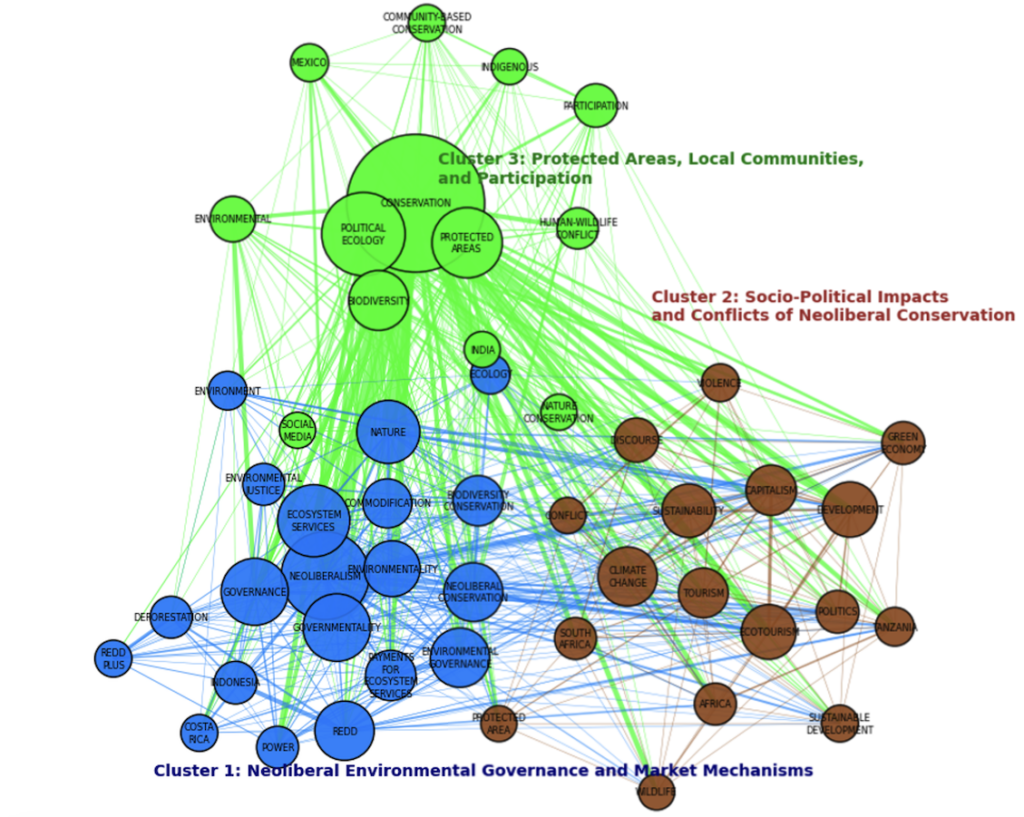
FIGURE 2. Fifty most used keywords (nodes) in the neoliberal conservation database of 2135 publications visualized in a co-occurrence network (node size, degree centrality [frequency of keyword occurrence]; colours, modularity class; lines, edges between nodes [i.e., thickness represents frequency of co-occurrence]).
Why this matters
Epistemic communities do more than produce academic papers. They shape how problems are defined, which solutions are considered viable, and whose knowledge counts in decision-making. In conservation, this has real consequences for policies that affect livelihoods, land rights, and ecosystems.
If critical conservation scholarship is serious about justice, decoloniality, and transformation, then it must also reflect on how its own knowledge practices reproduce or challenge inequality. Social network analysis offers one way, imperfect but illuminating, to make these dynamics visible.
Jim Igoe’s response to our paper
Following publication, our article prompted a thoughtful and generous commentary by Jim Igoe, while he notes the paper is “a welcome and overdue contribution”, he also raises important questions about what social network analysis can and cannot tell us about the evolution of epistemic communities.
We are deeply appreciative of this engagement. Rather than offering a point-by-point response, we see Igoe’s intervention as an invitation to slow down, reflect, and develop a more ambitious research agenda.
Igoe rightly notes that our analysis provides a structural snapshot: it maps the visible present but cannot fully capture how the field came into being, who was excluded along the way, or how alternative futures have been imagined, thwarted, and at times, partially realized… much of this nuance remains obscured in the simplified network figures. He challenges us to think beyond what can be easily quantified or visually mapped and to attend more closely to processes of exclusion, resistance, relational commitment, and epistemic violence.
We agree with much of this critique. Social network analysis, especially when based primarily on bibliometric data, has clear limitations. It struggles to capture dynamics such as:
- How networks evolve over time, and emergent dynamics and potential restructuring.
- How actors make use of their centrality in a social network, and how attributes like gender, race, geography, and generation intersect in messy real-world dynamics- quite unlike the visual of a clear and stagnant network.
- How power operates through informal relations and institutional gatekeeping.
- How scholars navigate tensions between critique, career precarity, and commitment to political and social ideals;
- And how knowledge circulates beyond academic publishing.
Addressing these questions requires more than better network metrics. It calls for combining social network analysis with other methods such as surveys, longitudinal network analysis, ethnography, oral histories, participatory mapping approaches like NetMap, and deeper engagement with social theory.
It requires asking bigger questions about how epistemic communities are made and remade, and about how scholars can participate responsibly in their unfolding. And this in turn encourages us to think how we can develop tools for disruption- to map alternative pathways for organising epistemic communities.
Looking forward…
Our paper emphasizes the need for more intersectional and decolonial perspectives to address enduring biases and gaps. Scholars should undertake more work on identified themes in currently excluded geographic regions through effective interdisciplinary collaborations and with local communities of research and practice and grassroots movements. There is a need to strengthen the field’s intellectual diversity, to centre issues of class, gender, and race, and to have a deeper engagement with feminist theory- beyond merely including more female voices.
We hope our paper will be a starting point that opens space for further inquiry into the politics of knowledge production in conservation. Future work will need to move beyond snapshots toward dynamic, relational, and historically grounded analyses, and to engage more directly with scholars, practitioners, and movements working within, against, and beyond dominant conservation paradigms.
If neoliberal conservation scholarship is to continue contributing to transformative praxis, it must remain open to critique- not only of markets and institutions, but also of itself. We hope this work, and the dialogue it has generated, helps move that conversation forward.