Authored by Ryan Unks
Misreading the Northeastern Laikipia landscape
Surprisingly, “community based conservancies” in Kenya often lack empirical support for claims that they benefit both wildlife and pastoralist livelihoods. Conservancies on community land have often been designed based on assumptions that pastoralism is degrading land and harmful to wildlife, and therefore establishment of protected areas and interventions in livestock systems are needed. Pastoralists in Kenya are appreciated for their “culture” in exoticized, tourist-friendly forms, but not so much for their systems of livestock production, ways of managing landscapes, and broader lifeways.
I did research for my PhD as a guest on collectively-titled land called Koija, in Laikipia, Kenya. I spent equal time working on understanding changes in pastoralist livelihoods, relationships between land use and vegetation change, and interviewing pastoralists about how they understood changes in their land.
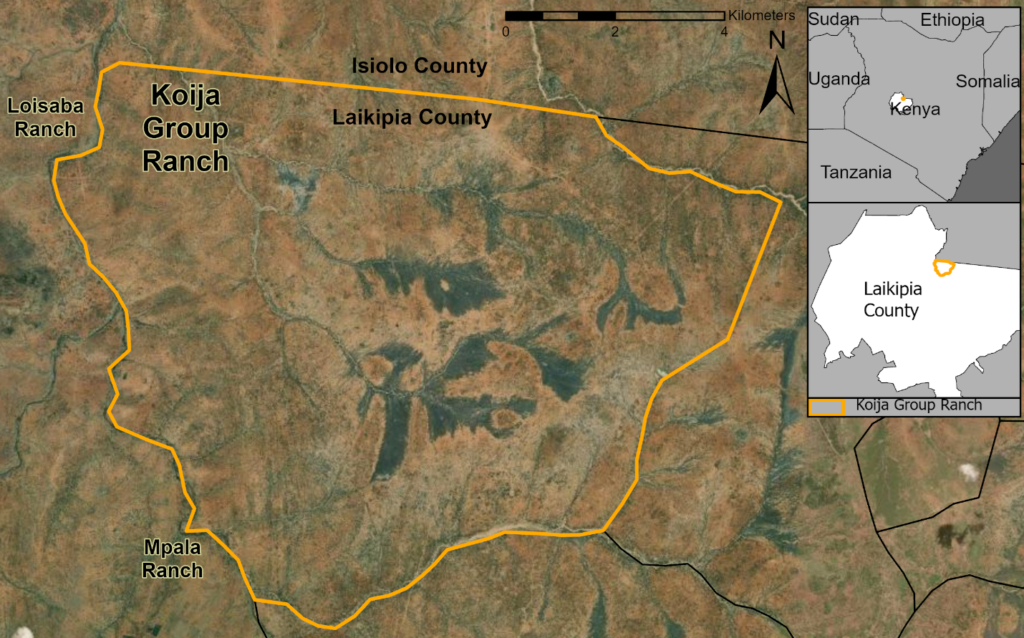
Koija Group Ranch, in Laikipia County, Kenya
Due to a past history of colonial-era land grabs and forced relocations, post-colonial consolidation of land and power by dominant groups, conflicts over administrative boundaries, and a wave of conservation outside of state protected areas, there was a high concentration of people and livestock at Koija, with it in effect being “squeezed from all sides“. The density of livestock was about 4 times higher than that on settler owned/operated ranches like Mpala and Loisaba whose tenure traces back to colonial-era land grabs. Mobility with cattle during drought and dry seasons had become nearly impossible except for the wealthiest at Koija as land control for conservation became tighter and tighter. From the perspective of a majority of conservationists, who often do not mention this history, high densities of livestock on Koija were leading to overgrazing and were responsible for the majority of changes in the land.
But to elders at Koija this history (even when told accurately), which led to increasingly sedentary pastoralism, did not adequately explain why the land was the way it was. Instead, things were much more complicated. The rain patterns had changed and the land dried out more now. Elephants had increased dramatically, and had enthusiastically knocked down a huge number of trees. Most surprisingly, there had been a forest that covered much of Koija, but that had mysteriously disappeared in the early 1990s. The livestock had some local impacts, especially where more sedentary, but many other factors, including rainfall patterns, extreme high temperatures, and elephant populations, had changed, and I was repeatedly told I needed to understand this to understand anything.
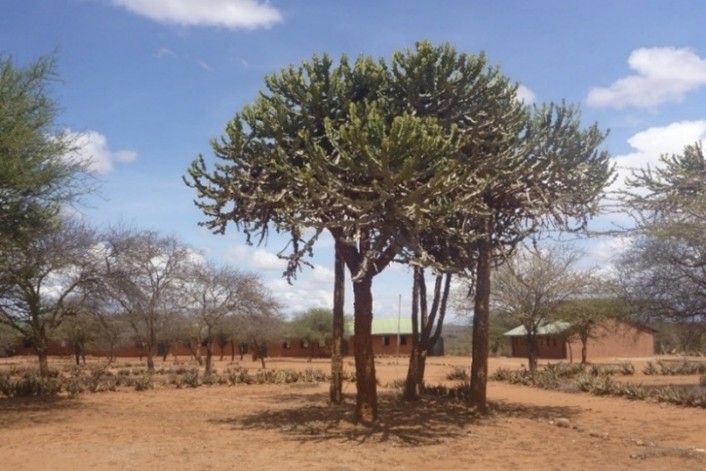
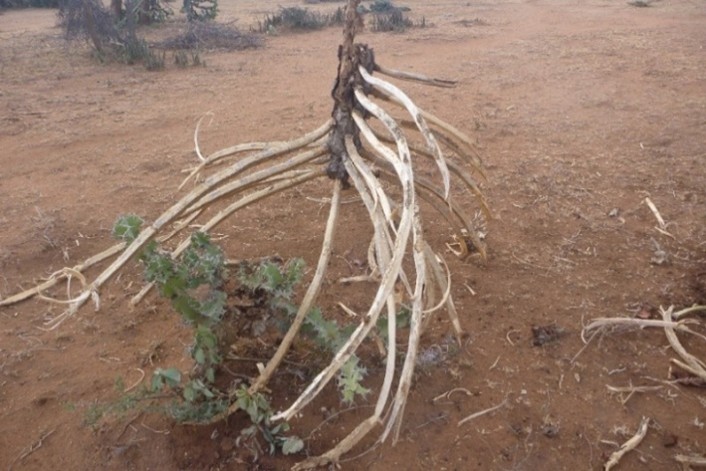
Euphorbia bussei species located behind fences which exclude elephants (top) and a recently toppled individual (bottom).
These experiences led to me reconsidering dominant narratives about how this land had come to be considered simply “degraded” according to ecological scientists, as well as dominant theories and methodologies that were the basis of rangeland ecology and conservation science in Kenya. I also became uncomfortable using frameworks of Ethnoecology and Indigenous Knowledge. The people I was spending time with at Koija were simply experts; they knew more about the land and vegetation there than any ecologist that I had met at the nearby ecological research center, their explanations of the fundamental problems constraining their livelihoods and land relations explained much more.
Years later, after a lot of work, together with colleagues, we’ve published an account of changes in the land at Koija that grappled with these divergent understandings. It is based on research I did together with Wachira Naiputari, who grew up on Koija and worked with me during my PhD, as well as my PhD advisor Lizzie King and other colleagues at the University of Georgia. This work considered the possibility that landscape changes could be driven by multiple interacting factors. We combined elder pastoralist experts’ understandings of historical landscape change, Lizzie and I’s long term research on livelihood and vegetation change, and remote-sensing that carefully controlled for the influence of climate on vegetation. Throughout the process we triangulated between the different epistemologies (i.e. ways of knowing) that are applied by pastoralist experts, social scientists, and dryland landscape ecologists.
We found no reason to believe that patterns of widespread tree losses could have been caused by livestock. Historical remote-sensing showed that tree-sized Euphorbia bussei had been lost across the extent of Koija, and as experts told us, probably due to elephants. Another, Euphorbia tirucali, which formerly was the key species in the large contiguous forest that had disappeared, seems most likely to have been extirpated due to climate change. Patterns of woody plant encroachment, rather than being driven by livestock, as often assumed, showed no associations with livestock use intensity. Their dramatic increase in specific areas with distinct soils and topography indicated that the patterns are more likely explained by a combination of climatic change and fire suppression. We found that patterns of decreases in herbaceous vegetation that deviated from what we would expect based on rainfall were mostly associated with increases in temperature since the 1980s. However, this pattern especially stood out in areas where conservation interventions had imposed a sedentarization policy AND where trees had been lost. That is, changes in herbaceous vegetation near settlements were also highly contingent on historical loss of trees, likely due to cascading influences on ecosystems caused by canopy losses. In short, we found that widespread landscape vegetation changes were more likely explained by a combination of climate, elephants, fire supression, and sedentarization policies rather than pastoralism per se.
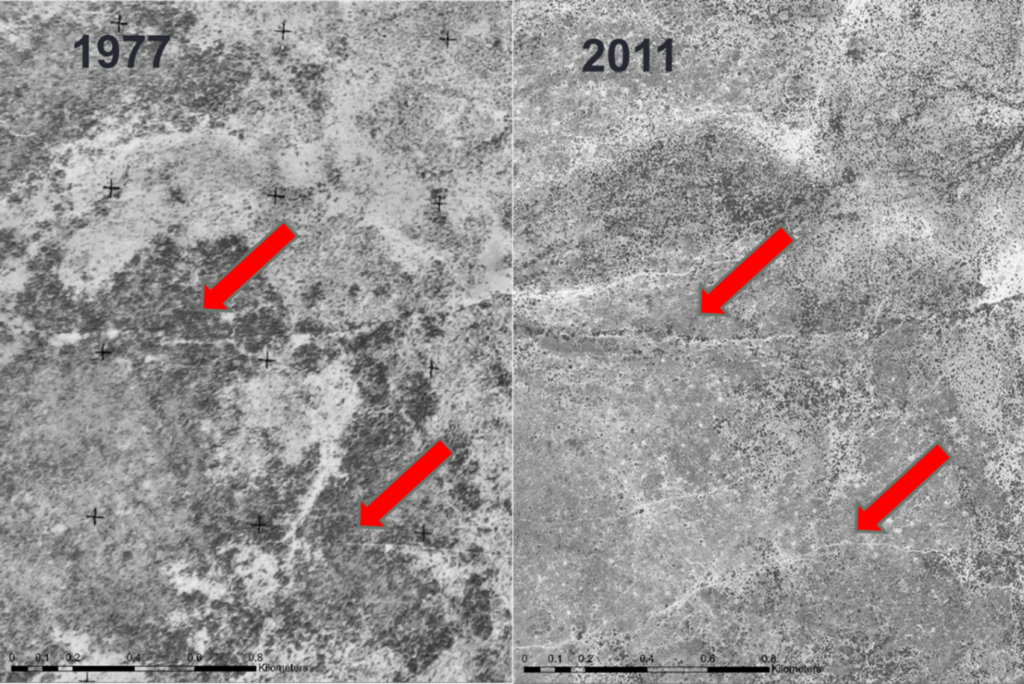
Area of formerly very dense Euphorbia tirucalli forest (left) today supporting dense perennial grasses, mixed forbs and shrubs, and much more sparse canopies (right).
Reflecting on this work now, perhaps the strangest thing is that it seems noteworthy at all. How was the story told for so long about places like Koija to be primarily about livestock density? Why isn’t it regular practice for studies about the impacts of pastoralism to carefully consider the influence of rainfall and increasing temperature, especially when rainfall patterns in the region are extremely variable in space and time, with Koija and nearby research centers being dramatically different? This variability has been well-known by ecologists since 1988, and presumably well-known by pastoralists for much, much longer. Why when studies ask about the impacts of pastoralism, do they not also consider widespread influences of fire-supression, changes in wild herbivore populations like elephants, and the influences of conservation practices on land use?
In short, part of conservation becoming more responsive to the realities of pastoralists requires reconsidering old biases against pastoralism and its consequences for landscapes and wildlife. Recognition of the positive synergies between biodiversity and pastoralism involves rethinking the long history of harmful practices that have excluded pastoralists from portions of landscapes or coerced them into reducing livestock in the name of conservation. To instead support positive synergies, conservation research and planning would need to center land relations in drylands from pastoralists’ perspectives. And it must be more attentive to its own role in marginalizing and constraining pastoralism.
Link to publication
R R Unks et al 2025 Environ. Res. Lett. 20 124084 https://iopscience.iop.org/article/10.1088/1748-9326/ae2491