
I recently spent a few days at the Forum segment of the IUCN World Conservation Congress (WCC) in Abu Dhabi, a huge gathering of over 10,000 participants and a vivid reminder of how diverse the conservation community is.
Following so many parallel events over four long days was as inspiring as it was exhausting. I focused mostly on sessions about expanding area-based conservation and its social implications, which are central to my work. This trip was also my first time joining the CONDJUST group in person after joining the project, which was a real highlight and made the whole experience even more insightful and enjoyable.
One of the most inspiring developments was the growing visibility and momentum of Indigenous Peoples’ and local community (IPLC)-led conservation. The Congress made it clear that IPLCs are not just stakeholders but stewards whose territories and governance systems already sustain much of the planet’s biodiversity. The Reimagining Conservation and Indigenous Peoples pavilions shared powerful stories of stewardship and resilience, while the first in-person, IUCN-hosted World Summit of Indigenous Peoples and Nature highlighted the role of Indigenous voices in shaping how conservation is defined and practiced.
Much of the WCC’s decision-making, including on these topics, happens beyond the Forum itself. Although I didn’t attend the Members’ Assembly, I followed with excitement some of its key outcomes. Several motions and resolutions adopted after the Forum mark important progress for advancing area-based conservation — including Motion 138 on recognising Territories of Life (ICCAs) and Motion 107 on scaling up Indigenous leadership. Together, they call for stronger recognition, support, and financing for community-led conservation and reaffirm key rights-based principles such as Free, Prior and Informed Consent (FPIC), secure land tenure, and respect for customary governance. Embedding these principles in IUCN policy shows a real shift in the global conservation narrative.
Seeing this momentum grow within IUCN’s direction and through the sessions I attended was encouraging. Though it also was a reminder that real progress will depend on how effectively these commitments turn into action — for instance, by securing tenure (as shown in examples from the session Advancing Indigenous Stewardship in Conservation), ensuring equitable access to finance (like those presented at Podong Indigenous Peoples Initiative: Impact, Lessons and Path Forward or discussed at the Funding justice… justly session), and embedding rights safeguards in national strategies to achieve Target 3 of the Kunming–Montreal Global Biodiversity Framework (GBF).
These discussions also made me reflect on my own research on spatial conservation planning (this is, the data and analyses that guide where and how conservation happens). The growing recognition of IPLC-led conservation poses both a challenge and an opportunity for planning. Unlike protected areas, these territories are rooted in lived stewardship and cultural continuity rather than external design. Mapping and recognising them is therefore most often about making visible what already exists and ensuring that formal planning builds upon these foundations and its recognition. Some sessions explored this connection (30×30: Clarifying What Counts Towards the Global Protection Target, for instance, provided clarity), but it still made me think more guidance is critically needed to adapt conservation planning to these realities.
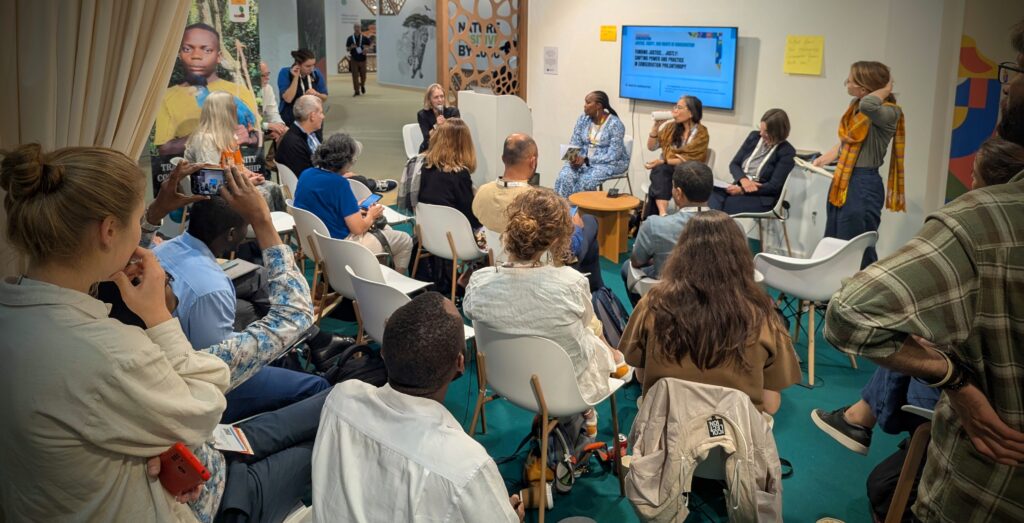
This link between data and equity also came through in the session Power in Data, where I presented. The discussions showed how biases in conservation data can reinforce inequities — a reminder that as planning becomes more open and technology-driven, inclusion must come not just from who can run analyses, but from how we design and interpret them.
What stood out most for me in Abu Dhabi was that conservation wants to evolve, moving from a model centred on protection and designation to one that is also grounded in recognition, partnership, and trust. With so many themes converging in such a big gathering, it sometimes felt like this was just one message among many. Yet across the halls and side events, I felt that this shift was real, and it left me with hope that this growing change can take root and lead to lasting progress.
Javier Fajardo
Oct 30, 2025