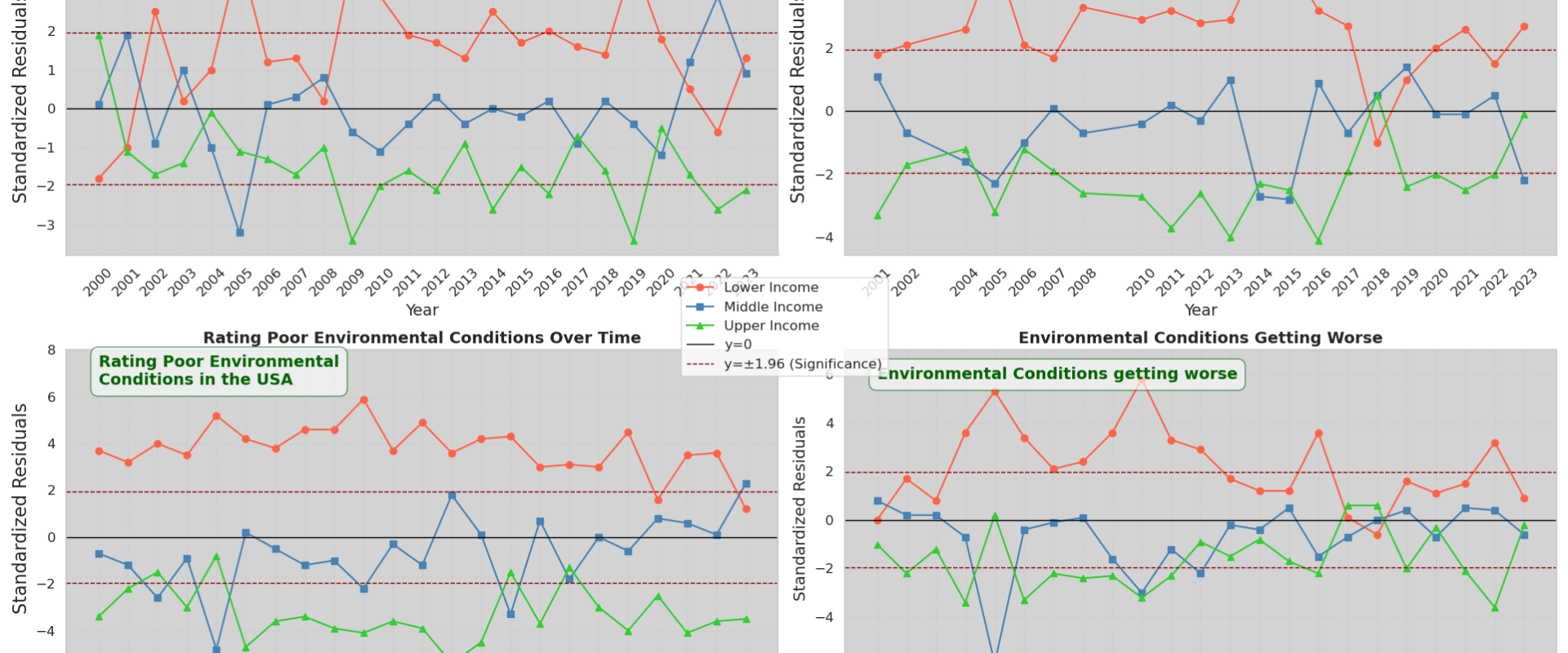
For decades, social scientists have believed that environmental concern grows with wealth —a theory backed by post-materialism. This influential idea suggests that once people or societies become affluent enough to meet basic needs, they naturally start caring more about environmental protection. But new research from our CONDJUST project, conducted by Marina Requena-i-Mora, Dan Brockington, and Forrest Fleischman, reveals a more complex reality that challenges this fundamental assumption and points toward what could be a “degrowth from below.”
The Post-Materialist Theory: What We Thought We Knew
Post-materialism proposes a simple equation: economic prosperity → environmental concern → environmental protection. Developed by Ronald Inglehart in the 1970s, this theory has shaped environmental policy for generations, suggesting that economic growth would naturally lead to greener societies as people moved beyond concerns about material survival. The logic seemed intuitive: wealthier societies have the luxury to care about the environment, while poor societies focus on immediate economic needs.
The Environmental Justice Challenge
Environmental justice scholars have long questioned this narrative. They argue that environmental concern often emerges not from wealth, but from experiencing environmental harm directly. James O’Connor’s theory of the “second contradiction of capitalism” suggests that capitalism undermines its own environmental conditions by depleting and polluting the resources it depends on, creating material contradictions that intensify socio-environmental struggles. Building on this, the “environmentalism of the poor” theory suggests that communities most affected by pollution and degradation develop the strongest environmental consciousness—not as a luxury, but as a necessity for survival.
What the Data Reveals: Three Key Findings
Our research team analyzed 23 years of U.S. public opinion data combined with carbon footprint measurements, uncovering patterns that fundamentally challenge post-materialist assumptions.
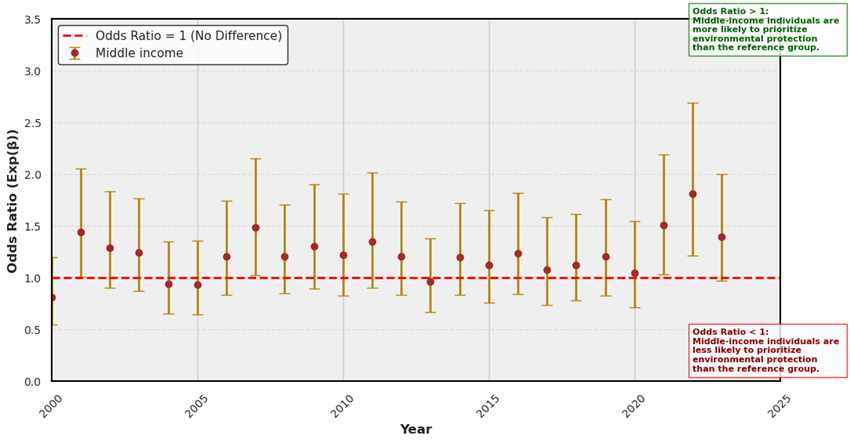
Contrary to post-materialist predictions, lower-income Americans consistently prioritize environmental protection over economic growth more than their wealthier counterparts. Binary logistic regressions controlling for age, race, sex, education, and political ideology show that, throughout most of the 2000–2023 period, lower-income individuals were significantly more likely to favour environmental protection than upper-income groups, with odds ratios frequently exceeding 1.5 and reaching close to 2.0 in several years. Only in three out of 23 years (2000, 2001, and 2013) did the odds ratio fall below 1.0, indicating that the pattern is remarkably stable across very different economic contexts — including recessions and periods of expansion alike.
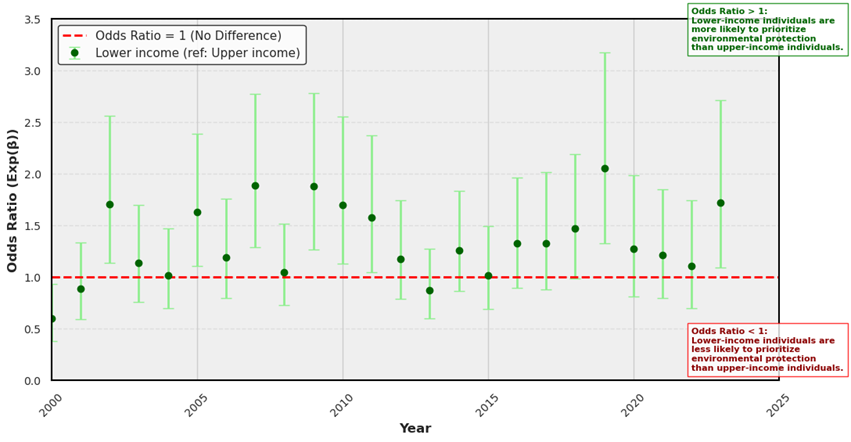
The figure reports the odds ratios from year-by-year binary logistic regressions of the preference for environmental protection over economic growth, comparing lower-income to upper-income respondents (reference category), with 95% confidence intervals. An odds ratio above 1.0 indicates that lower-income individuals are more likely to prioritise environmental protection than upper-income individuals.
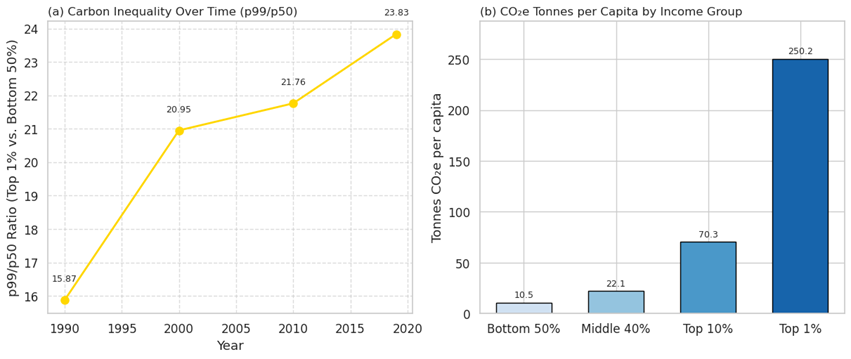
The data reveals a stark environmental injustice. The bottom 50% of earners emit only about 10 tonnes of CO2 per capita annually, while the top 1% emit a staggering 250 tonnes—a twenty-five-fold difference. The carbon inequality gap has widened dramatically since 1990, exposing the true drivers of our environmental crisis. Those who care most contribute least to the problem, while those with the largest environmental footprints show less environmental concern.
Lower-income groups consistently rate environmental conditions as poor, perceive them as worsening, and express greater worry about environmental quality. Adjusted standardized residual analysis across four environmental perception measures (2001–2023) shows that lower-income individuals stand out with persistently positive and significant residuals — indicating systematic overrepresentation relative to what would be expected by chance — across all four dimensions: preference for environmental protection, worry about environmental quality, rating of poor environmental conditions, and perception that conditions are getting worse. Upper-income groups, by contrast, exhibit negative residuals across the same measures, reflecting more favourable evaluations of environmental conditions. This pattern suggests that lower-income environmental concern is rooted in the lived experience of degradation — from exposure to pollution and environmental hazards to limited access to green spaces — rather than in abstract post-materialist values. Those who bear the greatest environmental burden, while contributing least to it, are precisely those who perceive and articulate it most clearly.
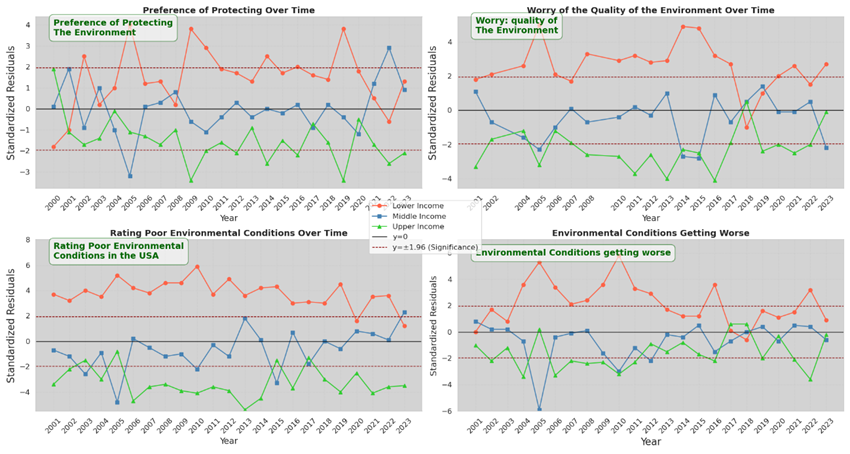
The figures present standardised residuals from bivariate analyses of environmental perceptions by income group in the US (2001–2023). Values above +1.96 or below −1.96 indicate statistically significant over- or under-representation of a given income group in that response category at the 95% confidence level.
The Affluent’s Environmental Blind Spot
The research exposes an uncomfortable truth about upper-income groups. Despite having the greatest resources to champion environmental causes and implement sustainable practices, they consistently show less environmental concern than their lower-income counterparts. Their privileged position allows them to escape immediate environmental impacts while their high-consumption lifestyles drive the very degradation they seem content to overlook. This disconnect between impact and awareness raises critical questions about whether economic power can truly drive meaningful environmental solutions when those who wield it remain detached from its consequences.
Middle-Income Patterns: The Neutral Zone
Middle-income groups occupy a middle ground, showing environmental preferences that fall between upper and lower-income groups. Their relationships with environmental attitudes are more variable and often not statistically significant, suggesting they may be influenced by both material and post-material factors depending on the specific environmental issue.
Reimagining Our Understanding of Environmental Values
These findings challenge fundamental assumptions about who prioritizes environmental protection over economic growth. Rather than this preference being a luxury of the affluent, it may be a necessity for the vulnerable. This research suggests we need to recognize that those willing to sacrifice economic growth for environmental protection may be those experiencing environmental harm firsthand, understand that economic hardship may paradoxically create stronger preferences for environmental preservation over economic expansion, and question whether waiting for prosperity to generate choices favoring environmental protection is the right approach.
The Environmental Justice Lesson
Our research reveals that the communities most impacted by environmental degradation—those with the lowest incomes and carbon footprints—demonstrate the highest willingness to prioritize environmental protection over economic growth. This suggests that genuine environmental solutions may emerge from listening to and empowering those who already choose ecological preservation over economic expansion through lived experience, rather than assuming that economic growth will automatically create these critical choices.
This pattern of environmental preferences among lower-income groups suggests the potential for “degrowth from below.” Rather than waiting for affluence to breed willingness to sacrifice economic growth for environmental protection, these communities demonstrate that alternatives to growth-centred development already emerge from those most affected by environmental harm. Their heightened preference for environmental protection over economic growth reflects not post-material values, but the immediate reality of living with environmental degradation.
The next time someone suggests that people need to be wealthy to prioritize environmental protection over economic expansion, this research provides compelling evidence for the opposite: those struggling with environmental realities may be our most authentic champions of degrowth principles.
This research was supported by the European Research Council under the Horizon Europe programme (Grant Agreement No. 101054259, Project CONDJUST).
Full citation: Requena-i-Mora, M., Brockington, D., & Fleischman, F. (2025). Eco-paradox USA: The relationships between economic growth and environmental concern generally, and by different income groups. Ecological Economics, 235, 108648. https://doi.org/10.1016/j.ecolecon.2025.108648