For decades, social scientists have believed that economic growth naturally leads to environmental consciousness—a theory supported by the post-materialist thesis. This framework suggests that as societies become wealthy enough to meet basic needs, they naturally develop deeper concern for environmental protection. But new research from our CONDJUST project reveals a more complex reality that highlights what environmental scholars call the “disconnection” or “alienation hypothesis”: the very process that creates environmental awareness also intensifies environmental degradation.
Understanding the Context
In our previous blog, we examined how different income groups relate to environmental protection, uncovering surprising patterns in environmental consciousness and carbon footprints across wealth levels. Now, turning from these income disparities to aggregate time-series data, we explore how economic cycles shape environmental awareness at the societal level and reveal another dimension of the environmental paradox: that environmental concern becomes structurally detached from its material consequences.
When Growth Creates Alienated Awareness
Our analysis of over 30 years of U.S. public opinion data reveals a striking pattern that confirms Karl Marx’s insights about alienation in modern capitalism. During economic expansions, public support for environmental protection systematically rises. As GDP per capita grows, so does society’s expressed willingness to prioritize environmental protection over further economic growth. This relationship persists even when controlling for other factors, with a 1% increase in GDP growth associated with nearly 2% higher environmental concern the following year.
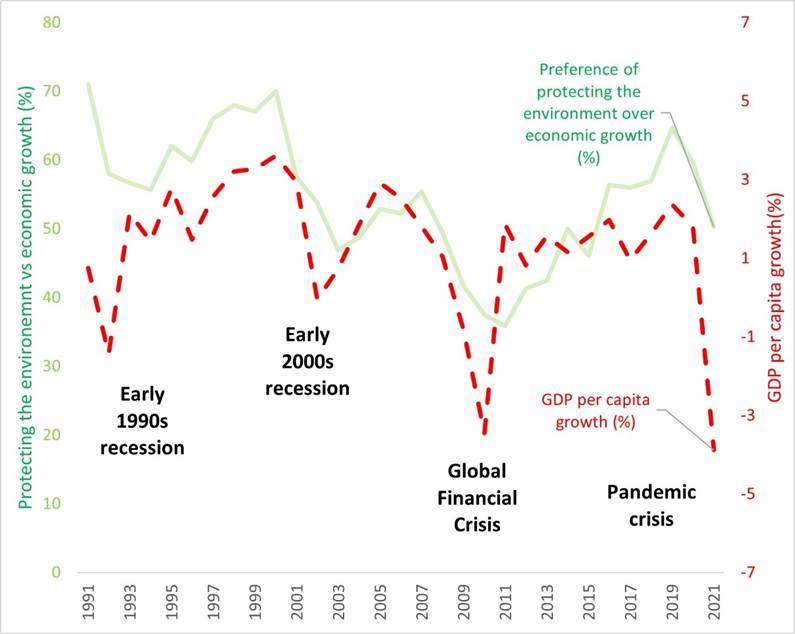
Yet this concern becomes what Marx might call a “fantastic form”—disconnected from its material basis. The same economic processes that generate environmental awareness also obscure their true environmental impact. This alienation creates a situation where environmental concern becomes a commodified narrative rather than a force for meaningful change.
The Disconnection Reveals Itself
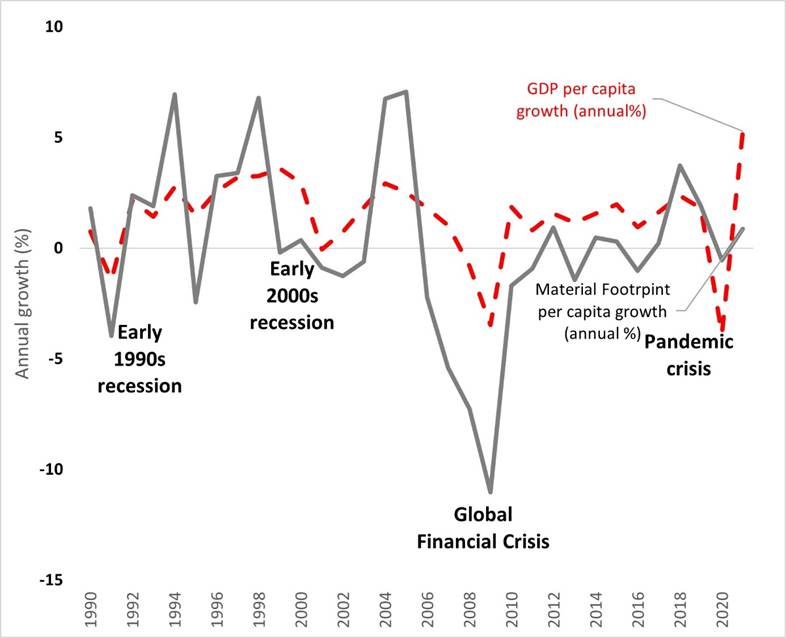
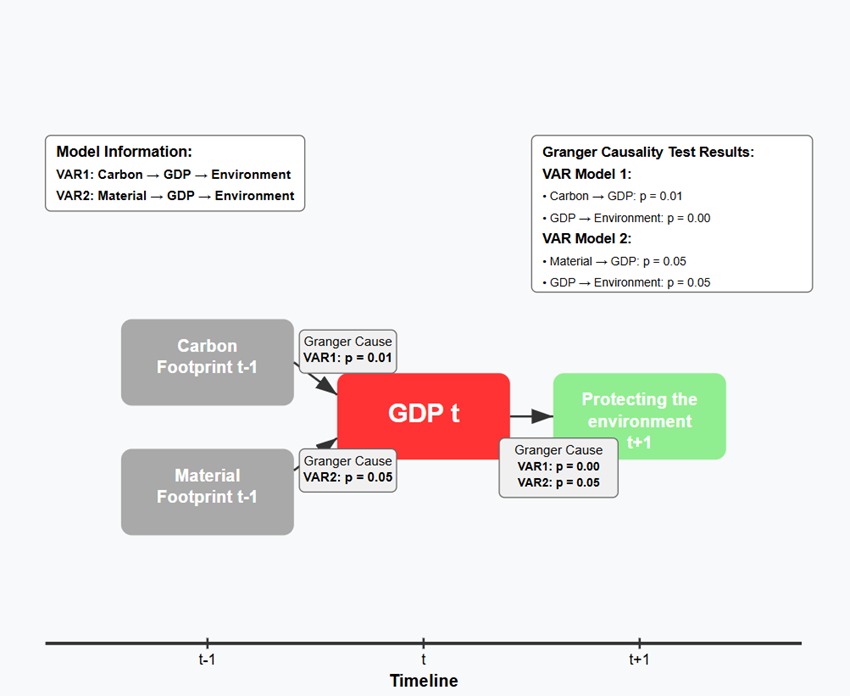
Here’s where the paradox crystallizes. While economic growth does foster environmental consciousness, it simultaneously accelerates environmental degradation. Our Vector Autoregression Analysis shows that both material footprint and carbon footprint increase substantially with GDP growth. For every 1% increase in economic expansion, material footprint grows by 1.31% and carbon emissions by 1.14%. The very engine driving environmental awareness is also the primary driver of environmental harm.
The Disconnection Hypothesis Confirmed
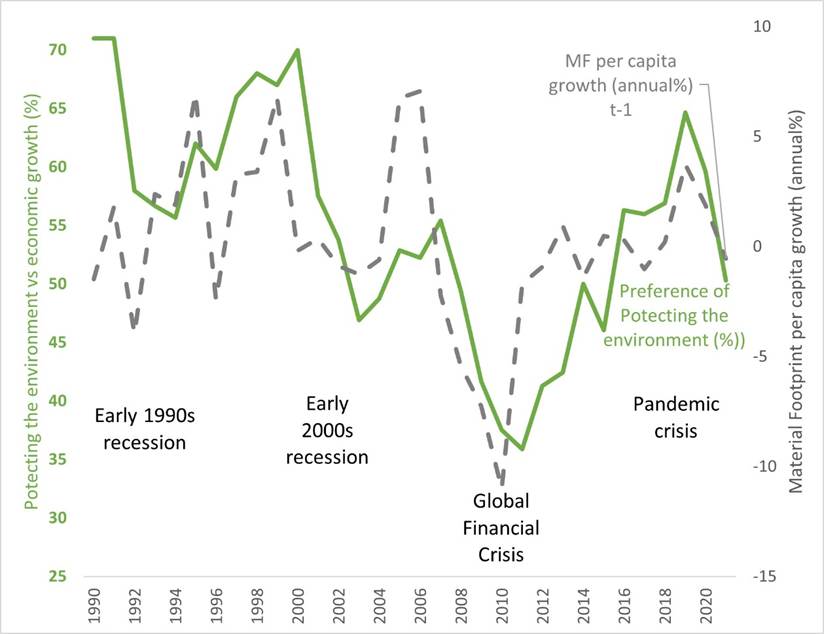
This finding supports what environmental scholars call the “disconnection hypothesis”: economic development creates conditions where societies become more concerned about environmental problems even as their economic activities worsen those very problems. Our research demonstrates that environmental preferences are influenced by past environmental impacts, with material and carbon footprints from previous years predicting higher environmental concern in subsequent periods.
The analysis reveals that environmental concern takes on what Marx described as “the fantastic form of a relation between things.” What is, in fact, a social relation between economic growth and environmental impact assumes the mystified form of environmental concern separated from the effects that this very concern helps produce through economic growth. Post-materialist environmental concern has little connection with the physical environment economic growth creates.
When Crisis Breaks the Illusion
Economic downturns provide moments when this alienation briefly lifts. During recessions—when environmental footprints actually decrease—public support for environmental protection consistently declines. This pattern appeared during every major U.S. economic crisis from the early 1990s through the pandemic. As economist Ronald Inglehart’s theory suggests, when economic security is threatened, environmental concerns take a backseat to immediate material needs.
The Structural Challenge of Alienated Environmentalism
This disconnection creates a structural challenge for environmental policy. The research shows that periods of high environmental concern paradoxically coincide with periods of intensified environmental damage. Economic growth not only drives increased consumption and emissions but also creates the social distance that allows societies to maintain environmental awareness without directly confronting the material consequences of their consumption patterns.
This alienated environmentalism enables what Dauvergne calls the “Environmentalism of the Rich”—a form of concern that manifests through ineffective “sustainable” consumption choices rather than systemic change. While post-materialist values may correlate with environmental consciousness, they produce an environmentalism disconnected from reducing actual environmental impact.
Breaking the Alienation
The findings point to a critical policy challenge: how to reconnect environmental consciousness with material reality. The current dependency of environmental values on economic growth suggests that sustainable transitions may require breaking this alienation—decoupling environmental consciousness from economic expansion while reconnecting it to its physical basis in reduced resource use and emissions.
Toward Reconciled Environmental Awareness
This research reveals that our current economic model creates an alienated form of environmentalism—one where concern grows alongside the very problems it seeks to address. Breaking this cycle may require fundamentally reconnecting environmental awareness with its material basis, moving beyond alienated post-material values toward environmental consciousness grounded in direct engagement with ecological limits.
The pattern is clear: economic growth generates alienated environmental concern that fails to address the environmental conditions it nominally aims to protect. Resolving this paradox may require overcoming the structural alienation built into growth-dependent environmentalism.
This research was supported by the European Research Council under the Horizon Europe programme (Grant Agreement No. 101054259, Project CONDJUST).
Full citation: Requena-i-Mora, M., Brockington, D., & Fleischman, F. (2025). Eco-paradox USA: The relationships between economic growth and environmental concern generally, and by different income groups. Ecological Economics, 235, 108648. https://doi.org/10.1016/j.ecolecon.2025.108648