Other Effective Conservation Measures (OECMs) were among the most prominent themes during the World Conservation Congress held in Abu Dhabi, United Arab Emirates, between October 9th and 15th, 2025.
OECMs—known in Spanish as Otras Medidas Efectivas de Conservación (OMEC) and in French as Autres Mesures de Conservation Efficace (ACME)—were formally adopted in 2018 by the Conference of the Parties to the Convention on Biological Diversity (CBD). They are defined as areas that, while not officially designated as protected areas, achieve long-term and effective in situ conservation of biodiversity, alongside other social, cultural, or economic objectives.
Since then, OECMs have gained increasing global attention as one of the key pathways to achieve Target 3 of the Global Biodiversity Framework—the commitment to conserve at least 30% of the planet’s land, inland waters, and oceans by 2030 (also known as 30×30).
At the Congress, at least 17 events directly mentioned OECMs in their titles, and many others included them in their session objectives as valuable mechanisms contributing to the 30×30 target. Over the course of the Congress, I attended multiple panels, workshops, and discussion spaces, gaining a sense of how OECMs are being interpreted and implemented across different regions, as well as the kinds of questions countries are facing as they integrate these measures into national conservation policies and frameworks.
OECMs in West and Central Africa
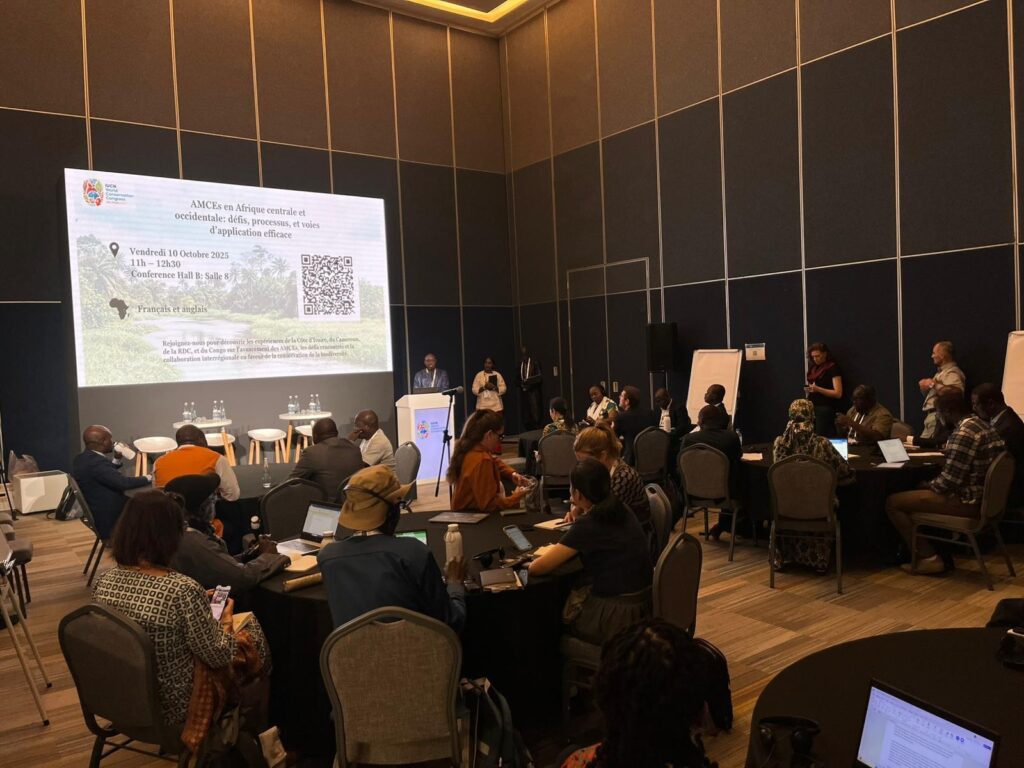
One of the sessions focused on progress in countries such as Côte d’Ivoire, Cameroon, and the Democratic Republic of the Congo. Governments in these contexts are beginning to interpret and adopt the IUCN criteria for identifying and recognising OECMs. Among the potential areas considered as OECMs are sacred forests, community forests, and buffer zones of Biosphere Reserves.
However, panellists noted that they are proceeding cautiously regarding the adoption of these measures. One key challenge they point out is aligning their national legal frameworks with international conservation targets. They also identified other barriers to the recognition of OECMs, including financial constraints, limited technical and institutional capacity, and the need for stronger political will to advance OECM identification and strengthening.
Civil society representatives expressed concern that OECMs could be interpreted as new categories of protected areas, thereby perpetuating top-down, state-led models of conservation rather than recognising existing governance systems and community practices that already contribute to biodiversity protection.
The discussion concluded with several open questions: What truly counts as an OECM? Who are the legitimate actors to identify, nominate, and govern these areas—the state, communities, or both? These questions underscore that OECMs are not only technical instruments but also political ones.
OECMs in Latin America

In Latin America, several countries have made significant progress in integrating OECMs into their national conservation policies. Colombia, for example, was one of the first countries globally, and the first in the region, to officially identify and recognise OECMs.
During the Congress, a regional panel brought together representatives from Panama, Belize, the Dominican Republic, Honduras, and Costa Rica, who presented the state of progress in their respective countries. Most are currently in the design and preparation stage, focusing on building institutional capacities, developing legal and policy frameworks, creating national technical committees, ensuring Free, Prior and Informed Consent (FPIC) processes with Indigenous and ethnic communities, and exploring financing mechanisms and incentives.
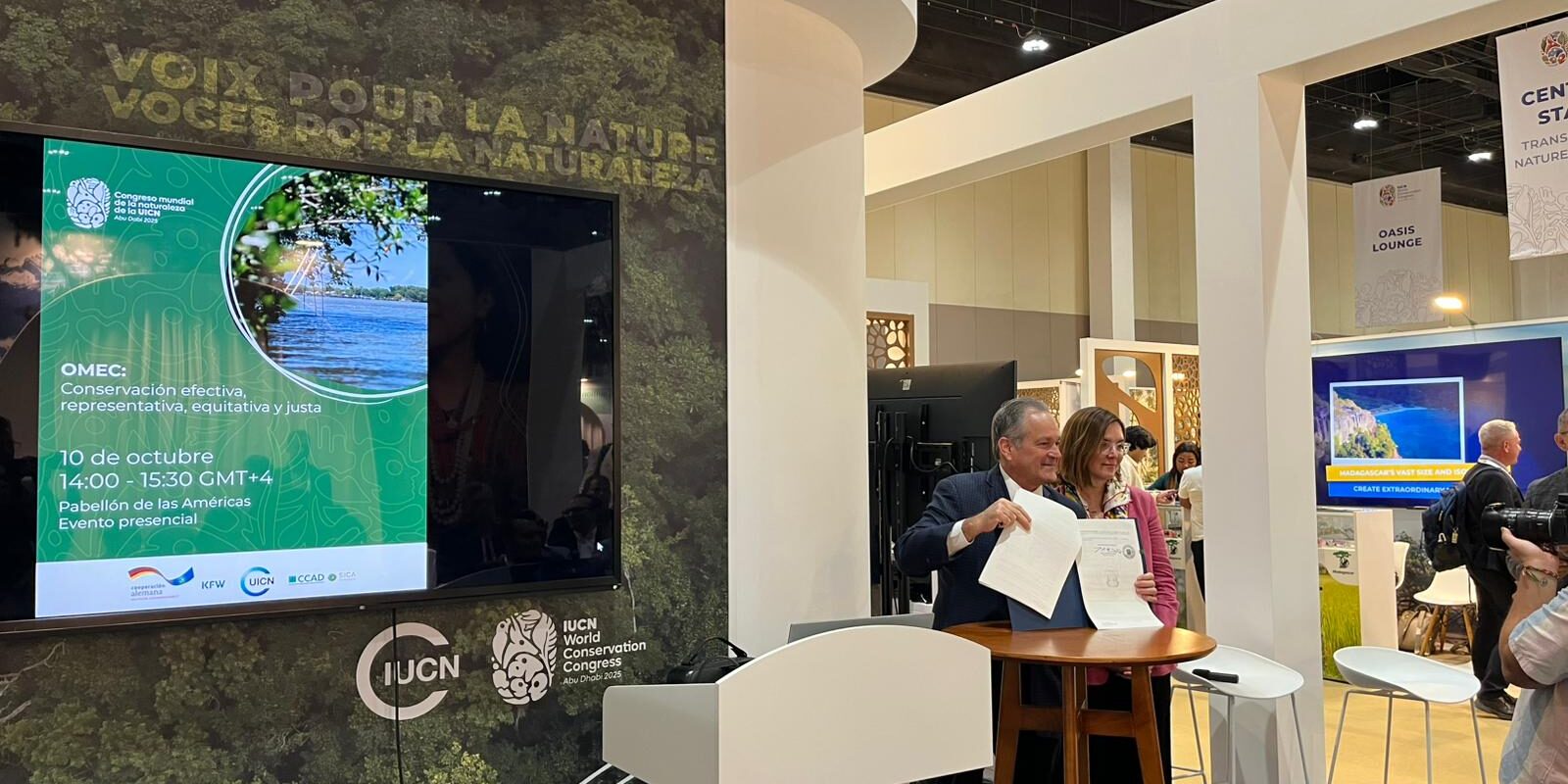
This panel reflected a predominantly institutional and state-driven vision of OECMs—as instruments through which national governments can demonstrate their commitment to global conservation goals. A notable moment was the public signing by Panama’s Minister of Environment of a formal resolution to begin implementing OECMs in the country.
However, Indigenous and community voices introduced crucial nuances. Ramiro Batzin, Indigenous Peoples’ Councillor to the IUCN, emphasised that conservation in Latin America must be understood through three complementary pathways: protected areas, OECMs, and the recognition of Indigenous territories and their contributions to biodiversity conservation. He underscored the need for genuine FPIC processes that respect Indigenous peoples’ autonomy and right to self-determination.
Echoing this, Camilo Niño, Technical Secretary of the National Commission of Indigenous Territories of Colombia, declared:
“If Target 3 does not contribute to the realisation of Indigenous Peoples’ rights, then this target is worthless.”
From his perspective, Indigenous-governed territories that contribute to conservation must be granted legal protection, which is “the first right among all rights.”
The Latin American case thus reveals contrasting visions around OECMs. While national governments see them as an opportunity to contribute to global conservation targets, Indigenous Peoples question whether these measures adequately recognise their contributions and strengthen their struggles for territorial sovereignty. This is why they are developing a proposal for what has been called “the third pathway” of Target 3: the recognition of Indigenous territories as a primary route for conservation.
Final reflections
OECMs have become a space where technical, political, and justice-oriented perspectives intersect. The experiences shared across regions reveal both the potential and the tensions in their implementation, between global frameworks and local realities, between state authority and community governance, and between international targets and territorial rights.
As this debate continues to evolve, several open questions remain: How can OECMs advance social justice rather than new exclusions? Who defines what counts as “effective conservation measures”? And who ultimately benefits from those definitions?