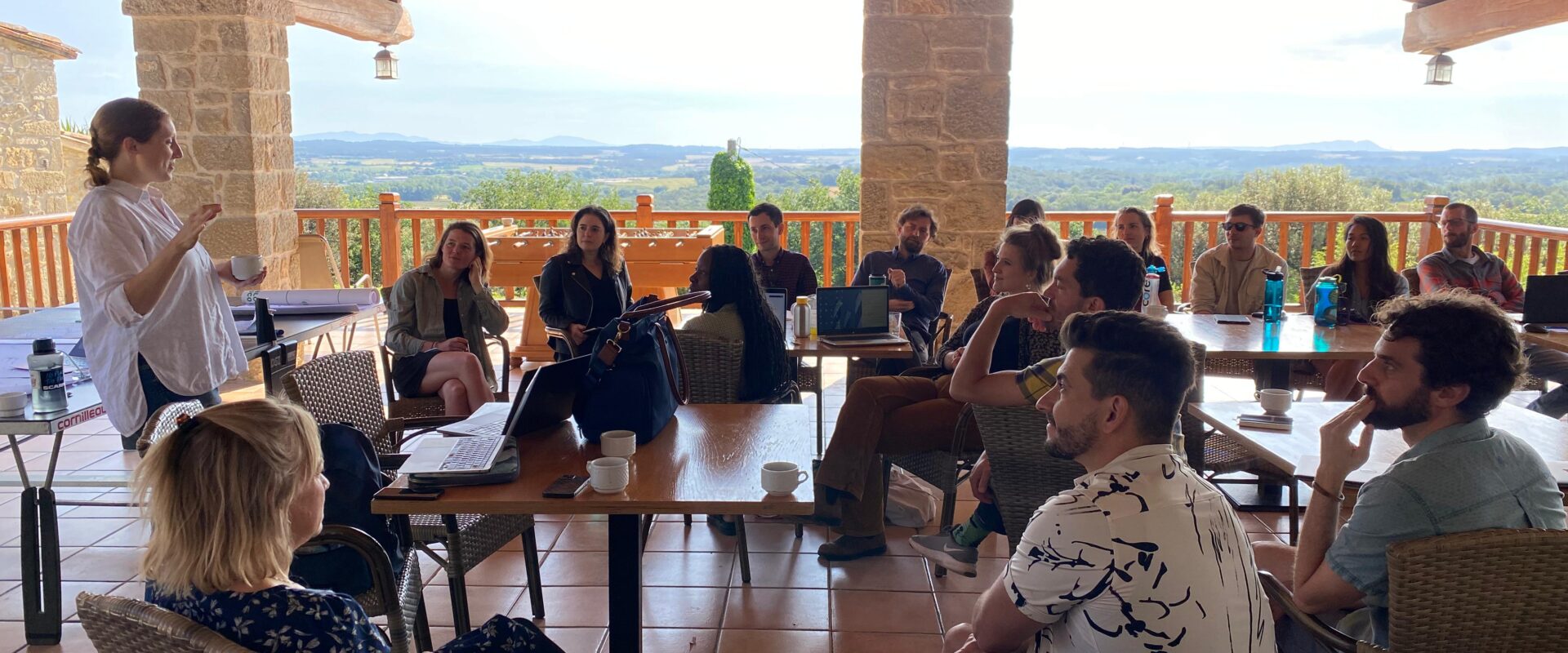
Conservation Data Justice Symposium, November 2027, Call for Participants
The field of Conservation Data Justice is flourishing with new projects, methods, data, publications, conceptual frameworks and collaborations.1-4 We propose to bring together new thinking and research on this topic in a physical meeting and eventual edited collection. Here we will share state-of-the-art research and advance conceptual, ethical, methodological and substantive understandings of conservation data justice in research and practice. Through this gathering, we intend to generate new research agendas, coalitions, teaching resources and practical initiatives. Contributions will be gathered into an Open Access book provisionally called A Compendium of Conservation Data Justice, with a suitable university press that will serve as a go-to source for further work on this topic.
We invite applications to join this meeting and contribute towards the book. Contributions are welcome from both scholars and practitioners, as broadly defined, across career stages whose work concretely engages with key themes around Conservation Data Justice. We especially welcome contributions emerging from collaborations across multiple communities involved in conservation more broadly, including, but not limited to, scholars, practitioners, members of local and Indigenous communities, elders, and other types of knowledge holders and conservation actors. This may mean you contribute to more than one of the papers. It may also mean that not all the authors of particular contributions can attend.
All attendees will need to contribute a written paper that will be shared 2 months before the symposium convenes (i.e., September 2027). The scope of what could be included is indicated in the draft Table of Contents of our proposed book that is given at the end of this document. This indicates some of the scope of what we are interested in, but we have not listed all the issues and topics that it could cover. Please consider these suggestions as prompts and starting points rather than any definitive list. We look forward to learning of possible contributions that we had not suggested.
The symposium will meet in person, in an appropriate venue in Catalunya, in early November 2027. The organisers will devote some time to planning informal activities, involving eating, walking and being together, which can be so important for a successful gathering. We expect to pay reasonable costs of participation for all who do not have sufficient funding.
To apply to take part please email symposiumcatalunya@proton.me with your proposed paper title and abstract of 300 words and any other relevant information about it by July 15th 2026. Please also state if you have your own funds to attend. We will inform attendees in early August 2026 whether their applications have been successful. For any queries please contact marinarequena@gmail.com.
The Organising Committee, April 2026
Valeria Zapata Giraldo, Ryan Unks, Jocelyne Sze, Laura Aileen Sauls, Marina Requena, Karla Ramirez Capetillo, Rose Pritchard, Marie Pratzer, Sahil Nijhawan, Danielle Latreche, Naomi Millner, Tobias Kuemmerle, Munib Khanyari, Jenny Goldstein, Bilal Butt, Brittany Bunce & Dan Brockington
This Symposium is funded by an Advanced ERC Fellowship ´CONDJUST´ no 101054259
Indicative Table of Contents
Theory and Concepts
Antecedents of Conservation Data Justice
Theories of Justice – epistemic and data
Politics of absence and invisibility in conservation data
Data sovereignty, Indigenous and local people’s rights
Temporality and data justice
Asymmetries in data production
Subjective notions of and place-based approaches to data justice
Artificial Intelligence, LLMs and Conservation Data Justice
Issues of scale in conservation data and notions of justice
Data uncertainty and Justice
Proximity, relationality and embodied labour in the production of conservation data
Scientific uncertainty and conservation data justice
Methods for looking critically at Data Justice
Approaching Justice through Epistemic Communities
Understanding Indicators, Composite Indicators and Proxies
Decomposing Models for Spatial Planning and Conservation
Data Journeys
Examples and Issues
In this section we will compile examples, ethnographic accounts (including autoethnographies of researcher’s relationships with the process of data generation and the data itself),and case studies of data justice and injustice in conservation, including strategies for more just conservation data practices. Topics could include (but are not limited to):
Studies of specific GIS layers – IPL, Ecoregions, Human Footprint, Pastoralism
The Politics of Specific Indicators and Models
Carbon accounting and data justice
Ethnographies of data justice and data injustice
AI, Surveillance and Conservation: monitoring/predictive AI
Counting and Mapping Species and their Endangerment
Mapping and Knowing Oceans
Freshwater and data justice
Restoration and Data Justice
Prioritisation and Data Justice
Insurance, Data and Conservation
Biodiversity data in climate justice
The role of data in conservation finance
Data driven conservation in urban areas
Biopiracy/genomics and biodiversity data
Land tenure/land rights
Gender, labour, data production
The challenges of understanding land use
Thorny Issues, Conservation and Data Futures
Rapid technological change
Rights to secrecy and not being known
Open data and its discontents
Technologically mediated disconnection with the process of conservation data generation
Where are conservation data going?
Works cited
1Goldstein, J. & Nost, E. The Nature of Data. Infrastructures, Environments, Politics. (University of Nebraska Press, 2022).
2Sze, J. S. & Sauls, L. A. Prospects and perils in the geospatial turn of conservation. Conservation Biology 39, e70145 (2025). https://doi.org:https://doi.org/10.1111/cobi.70145
3Pritchard, R., Sauls, L. A., Oldekop, J. A., Kiwango, W. A. & Brockington, D. Data justice and biodiversity conservation. Conservation Biology 36, e13919 (2022).
4Goldstein, J. E.et al. Environmental data justice is key for developing more effective area-based conservation approaches. Nature Reviews Biodiversity 2, 116-126 (2026). https://doi.org:10.1038/s44358-025-00126-w